
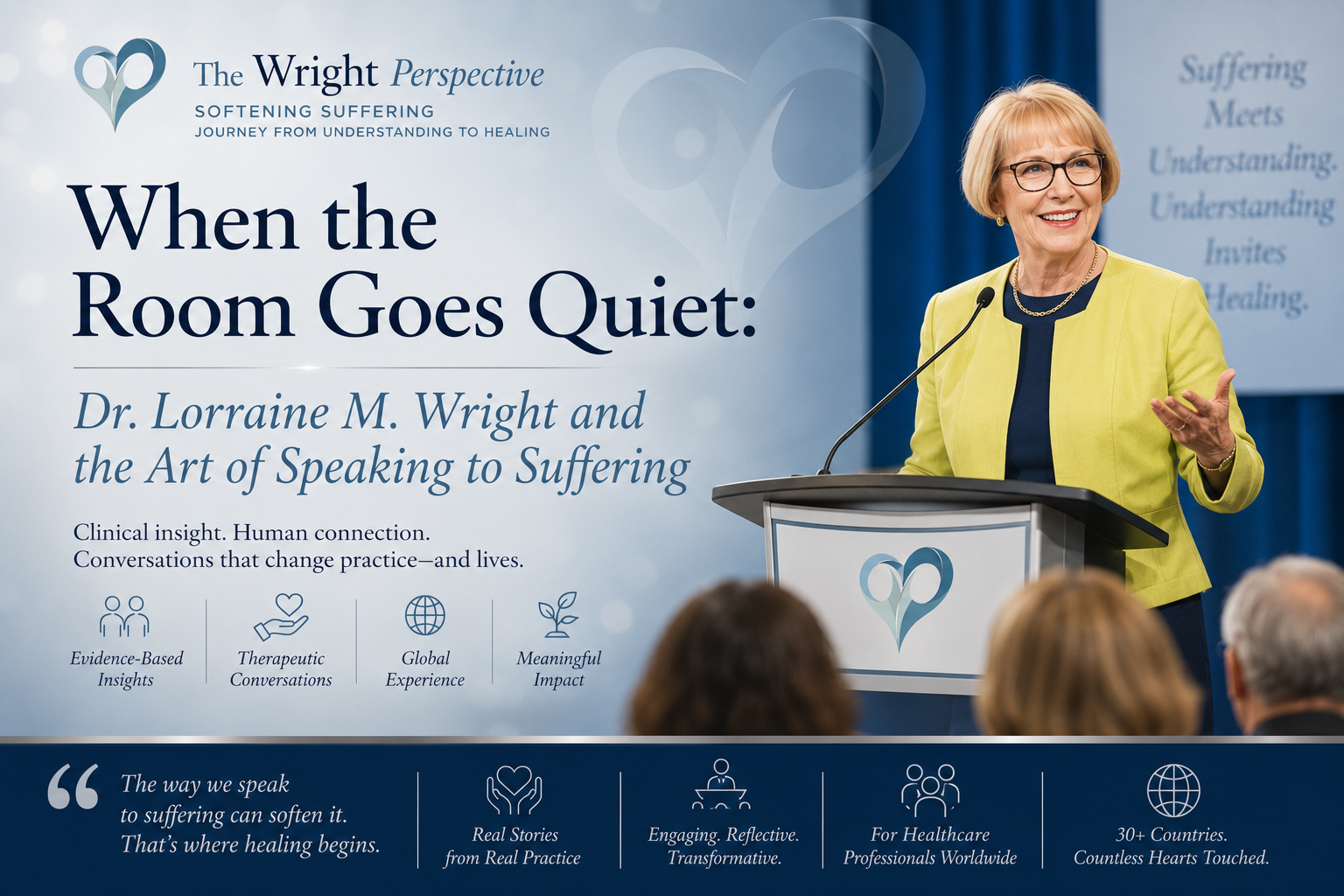
There is a particular kind of silence that falls over a conference room when a speaker has stopped performing and started speaking truth and touching hearts. I have been in many conference rooms over the course of my career — in Bangkok and Banff, in Timor-Leste and Taiwan, in lecture halls at the University of Calgary and in hospital auditoriums on five continents. I know what it feels like when an audience is politely attentive. I also know what it feels like when something shifts — when the audience is no longer watching a presentation, but recognizing something they had not yet known how to name.
That shift is what I try to create every time I speak. Through clinical theory and clinical stories, I invite the audience to engage in deep reflection on their practice and the great privilege we, as health professionals, have to soften illness-related suffering and invite illness-related healing.
The most important thing I can do in a room full of healthcare professionals is remind them that the suffering in front of them is real — and that they have more power to soften it than they know.
Why This Work Matters
Over four decades as a clinician, educator, and researcher, I have come to believe that one of the most underestimated forces in healthcare is the therapeutic conversation. Not the treatment plan, not the diagnostic workup, not the intervention — the conversation. What is said in a room between a healthcare professional and a patient and/or their family can soften or deepen suffering. Can open a door to healing or quietly close it.
This is what I bring to a speaking engagement. Not a motivational message. Not a summary of research findings, though the research is cited, deeply embedded in everything I offer. What I bring is 45 years of evidence — from clinical practice, from the families I have worked with, from the professionals I have trained — that the way we talk to people, the relationship we form in the clinical room, in their most vulnerable moments, changes what happens next.
I speak to health care professionals from the Illness Beliefs Model, which I co-developed with Dr. Janice Bell. I speak from the Trinity Model, which brings together beliefs, suffering, and spirituality as inseparable dimensions of human experience. And I speak from my own life experiences, including the losses and the moments of doubt and uncertainty that have made me not just a clinician but a fellow human being who understands, in a personal way, what it means to suffer and to begin healing.
Topics That Move Participants
The topics I am most frequently invited to speak on have one thing in common: they address the parts of healthcare and human experience that are hardest to talk about. Illness suffering and how our illness beliefs invite suffering. End-of-life transitions and what families need most. Medical Assistance in Dying and the clinical and spiritual complexity it introduces to every room where it is discussed. Spirituality and its role in illness and healing. Therapeutic conversations — what they are, why they work, and how healthcare professionals can learn to offer them.
I have delivered keynote addresses and workshops at the International Conferences in Family Nursing in 15 different countries, on Spirituality and Psychology in Bangkok, at universities across Europe, Southeast Asia, and South America, and at nursing and healthcare conferences in Canada and around the world. I have presented to audiences of 20 and audiences of 2,000. The topic changes slightly; the intention does not.
What I have found, consistently, across 30 plus countries and counting, that suffering is universal. Healthcare professionals everywhere want to do know how to soften suffering of person in their care. They want to know how to be in a room with someone in deep suffering without either prematurely fixing it or being overwhelmed by it. That is what I teach.
What Attendees Experience
I was once approached after a conference keynote by a palliative care nurse who had been working in end-of-life settings for 22 years. She told me that after hearing me speak, she had realized she had been entering patients’ rooms for two decades with a constraining belief she had never examined — that there was nothing more she could offer once the treatments were finished. She went back to work the following week and held a different kind of conversation with a dying patient. She wrote to me three months later to tell me what had happened in that room.
This is the kind of impact I work toward. A letter, three months later, that begins: ‘Something changed.’
Conference organizers tell me that my sessions are consistently among the most discussed afterward — not because I deliver information, but because I ask questions, invite reflections, and touch hearts. I leave audiences with something to sit with, something to take back into their clinical practice, and something to share with their colleagues that changes the conversation in their organization.
An Invitation to Conference Organizers
If you are planning a conference, symposium, workshop, professional development event, or institutional training day and you are looking for a speaker who will do more than fill time — who will shift the room — I would welcome a conversation.
I speak to healthcare professionals, academic institutions, family nursing associations, palliative care organizations, spiritual care providers, and interdisciplinary teams working in complex care settings. I am available for keynote addresses, half-day workshops, full-day intensives, and multi-session professional development programs.
My work has been described as ‘the most clinically useful presentation I have ever attended’ and ‘the thing I did not know I needed to hear.’ I am not in the business of leaving an audience feeling good about what they already know. I am in the business of giving them something new to believe — and therefore something new to offer the people in their care.
To enquire about booking Dr. Lorraine M. Wright for a speaking engagement:
Frequently Asked Questions
Dr. Wright speaks on illness suffering and the Illness Beliefs Model, therapeutic conversations in healthcare, Medical Assistance in Dying (MAID), end-of-life care and transitions, spirituality and its role in illness and healing, family nursing, and compassionate care. Her presentations are appropriate for nursing conferences, medical symposia, palliative care organizations, spiritual care providers, and academic institutions.
Dr. Wright is available for keynote addresses, half-day and full-day workshops, multi-session professional development programs, hospital and institutional in-service training, and academic lectures. She has presented to audiences ranging from small interdisciplinary teams to international conferences of several thousand attendees.
Yes. Dr. Wright has presented in over 30 countries and continues to accept international speaking invitations. Recent and upcoming engagements include Bangkok, Timor-Leste, Umea University in Sweden, and Queen’s University in Canada. She is available for both in-person and virtual presentations.
Dr. Wright combines 45 years of clinical experience, internationally recognized research, and a deeply personal communication style that creates genuine engagement rather than passive listening. Attendees consistently describe her presentations as transformative — not because of the information delivered, but because of the questions she asks and the beliefs she examines. Her sessions are among the most discussed and referenced at the events where she presents.
Dr. Wright’s presentations are designed for nurses, physicians, social workers, psychologists, chaplains, spiritual care providers, palliative care professionals, family therapists, and healthcare administrators — anyone whose work brings them into contact with seriously ill patients and their families, and who wants to do that work with greater compassion, skill, and clinical confidence.
To enquire about availability, topics, and fees for speaking engagements, visit lorrainewright.com/speaking/ or use the contact form at lorrainewright.com/contact/. Dr. Wright’s team will respond to all serious enquiries promptly.

